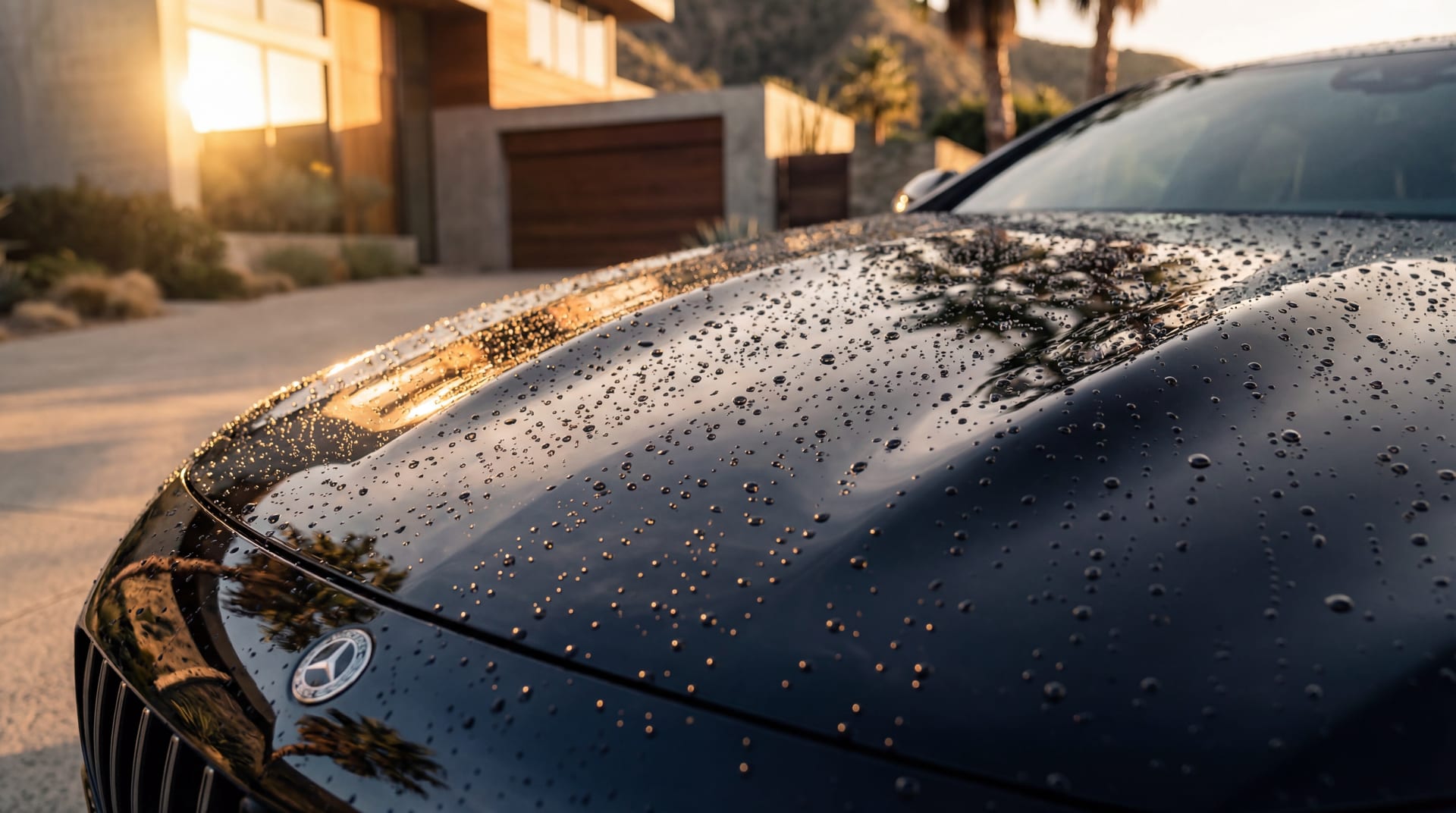
You have heard that ceramic coating and paint protection film (PPF) both protect your car's paint. But they protect against fundamentally different things. Choosing the wrong one — or applying just one when you need both — can leave your vehicle vulnerable to exactly the type of damage you were trying to avoid. In San Diego, where extreme UV, salt air, highway debris, and year-round driving converge, understanding the difference is not optional. It is the difference between real protection and an expensive false sense of security.
After nearly three decades of protecting vehicles across San Diego County — from beachfront Coronado daily drivers to weekend canyon cars in Rancho Santa Fe — we have installed thousands of ceramic coatings and hundreds of PPF wraps. This guide reflects what we have learned about which solution works best for which situation, and when combining both is the only smart move.
What Is Ceramic Coating?
Ceramic coating is a liquid polymer containing silicon dioxide (SiO2) nanoparticles that chemically bonds to your vehicle's clear coat at the molecular level. Once cured, it creates an extremely hard, hydrophobic, UV-resistant layer that cannot be washed or rubbed off. It is a chemical barrier — it blocks UV radiation, repels water and contaminants, resists chemical etching from bird droppings and tree sap, and prevents oxidation from San Diego's relentless salt air.
Professional-grade ceramic coatings like Ceramic Pro and Gtechniq Crystal Serum (both of which we are certified to install) achieve 9H hardness on the pencil hardness scale. This means they resist light scratches, swirl marks, and surface marring far better than unprotected or waxed clear coat. However — and this is critical — ceramic coating is only 2 to 3 microns thick. It cannot absorb significant physical impacts.
Our ceramic coating tiers at Awesome Guys Auto Care: the 1-Year Basic runs $450 to $650 depending on vehicle size, the 3-Year Premium is $800 to $1,000, and the 5-Year Luxury is $1,200 to $1,600. Every tier includes paint correction and full decontamination. See our pricing page for exact figures by vehicle category.
What Is Paint Protection Film (PPF)?
Paint protection film is a thermoplastic polyurethane film — typically 6 to 8 mils thick (150 to 200 microns) — that is precision-cut and applied directly over your vehicle's paint. Unlike ceramic coating's chemical protection, PPF is a physical shield. It absorbs impacts from rock chips, road debris, gravel spray, shopping cart dings, and even minor key scratches. Premium films from brands like XPEL Ultimate Plus and SunTek Ultra feature self-healing top coats that repair light scratches with heat exposure — the San Diego sun handles this automatically.
PPF is virtually invisible when professionally installed. The film conforms to complex curves, edges, and body lines using heat-forming techniques. Computer-cut patterns ensure exact coverage without visible seams. The result is a physical armor layer that does not change the appearance of your vehicle but dramatically changes its resistance to real-world damage.
PPF pricing varies significantly by coverage area. A full front-end package — hood, front bumper, fenders, mirrors, and headlights — typically runs $1,500 to $5,000. Full-body PPF coverage ranges from $5,000 to $8,000 depending on vehicle size, paint complexity, and film brand. Partial options like hood-and-bumper-only start around $800 to $1,200.
Head-to-Head Comparison: Ceramic vs PPF
| Feature | Ceramic Coating | Paint Protection Film |
|---|---|---|
| Protection Type | Chemical barrier | Physical barrier |
| Thickness | 2-3 microns | 150-200 microns |
| Rock Chip Protection | No | Yes — absorbs impacts |
| UV Protection | Excellent | Good (with UV inhibitors) |
| Hydrophobic Effect | Extreme — water sheets off | Moderate (unless ceramic-coated) |
| Self-Healing | No | Yes — heat activates repair |
| Chemical Resistance | Excellent (bird droppings, sap, salt) | Good |
| Durability | 1-5 years | 7-10 years |
| Coverage | Entire vehicle (including wheels, glass, trim) | Typically high-impact zones only |
| Cost (full front) | $450-$1,600 (whole car) | $1,500-$5,000 |
| Salt Air Defense | Excellent — non-porous barrier | Good — physical barrier |
Why San Diego Makes This Decision Harder
Most online comparisons of ceramic coating vs PPF are written for generic climates. San Diego is not a generic climate. Your vehicle faces a unique combination of threats that most cities simply do not have:
Extreme UV exposure: San Diego averages over 300 sunny days per year with a UV index regularly exceeding 10 during summer. UV breaks down both unprotected clear coat and — over time — paint protection film. Ceramic coating's UV-blocking properties are superior to PPF alone in this regard. If you have PPF without ceramic on top, the film itself will yellow and degrade faster in San Diego's sun than it would in Seattle or Portland.
Coastal salt air: If you live or park in La Jolla, Coronado, Pacific Beach, Ocean Beach, Point Loma, Imperial Beach, or Del Mar, salt particles are depositing on your paint every day. Salt is hygroscopic — it attracts moisture and creates corrosion cells on any unprotected surface. Ceramic coating's non-porous barrier is the best defense against this chemical attack. PPF also blocks salt, but without the hydrophobic shedding effect, salt-laden water can pool on film edges and cause issues over time.
Highway debris: The I-5, I-15, I-805, and SR-163 are notorious for construction debris, gravel, and truck tire fragments. If you commute on any of these corridors daily, your front end takes hundreds of micro-impacts per week that ceramic coating simply cannot stop. This is where PPF earns its money — a single rock chip repair on a luxury vehicle can cost $300 to $800, and three or four chips quickly exceed the cost of full-front PPF.
Year-round driving: Unlike seasonal climates where cars spend months in garages during winter, San Diego vehicles are driven and exposed 365 days a year. There is no off-season for UV damage, no break from salt air, no period of low-traffic highways. Your protection needs to be comprehensive and durable — not just adequate.
When to Choose Ceramic Coating Only
Ceramic coating alone is the right choice when your primary concerns are environmental — UV damage, oxidation, salt air corrosion, bird droppings, tree sap, water spots, and ease of maintenance. It is ideal when:
You mostly drive surface streets. If your commute is local — Del Mar to Solana Beach, Hillcrest to downtown, Scripps Ranch to Mira Mesa — you are not facing constant highway debris. Surface street driving at 25 to 45 mph rarely generates rock chips. Ceramic handles everything else you encounter.
Your budget is under $2,000. A 3-year ceramic coating at $800 to $1,000 provides excellent all-around protection at a fraction of full PPF cost. It is the best value per dollar of protection for most San Diego drivers. As we detailed in our ceramic coating vs wax comparison, ceramic pays for itself versus repeated waxing within 15 months.
You prioritize appearance and maintenance. Nothing matches ceramic coating's hydrophobic effect and self-cleaning properties. Dirt, dust, pollen, and water slide off the surface. Washing takes half the time. The gloss depth and clarity are stunning. If your primary motivation is keeping your car looking showroom-fresh with minimal effort, ceramic is the answer.
When to Choose PPF Only
PPF without ceramic coating makes sense in very specific scenarios — honestly, fewer than most people think:
Track or canyon driving. If you regularly take your car through Palomar Mountain, Sunrise Highway, or to events at Chuckwalla Valley Raceway, you face gravel, debris, and physical hazards that demand impact protection. PPF on high-impact areas is non-negotiable for these conditions.
Extreme highway commuting. Drivers covering 50 or more highway miles daily on the I-15 or I-5 face significantly more debris exposure than average. If your front end is already showing chips after a year of driving, PPF is the direct solution. That said, we almost always recommend adding ceramic on top — which brings us to the best option for most serious owners.
NOT SURE WHICH YOU NEED?
We will inspect your vehicle, assess your driving patterns and parking situation, and recommend the right protection strategy — no upselling, just honest advice from 28 years of experience.
calendar_month BOOK FREE CONSULTATIONThe Best Option: PPF + Ceramic Coating Together
For owners who want comprehensive protection, the combination of PPF on high-impact zones plus ceramic coating over the entire vehicle — including on top of the PPF — is the gold standard. This is what we recommend for luxury, exotic, and high-value vehicles, and for any driver who wants maximum defense against San Diego's full range of threats.
Here is why the combination works so well: PPF on the hood, front bumper, fenders, mirrors, rocker panels, and rear bumper handles all physical impacts — rock chips, door dings, shopping cart bumps, and road debris. Ceramic coating over the entire vehicle, including on top of the PPF, handles all environmental threats — UV radiation, salt air, chemical contaminants, water spotting, and oxidation.
But the combination does something neither product can do alone: ceramic coating on top of PPF prevents the film from yellowing, staining, and losing its clarity over time. The ceramic's hydrophobic layer also makes PPF dramatically easier to clean — contaminants that would normally bond to the film's surface slide right off. This extends the functional life of the PPF well beyond its rated durability.
For a typical sedan or SUV, a full-front PPF package plus whole-car ceramic coating runs approximately $2,500 to $4,000 — significantly less than full-body PPF, but with near-complete protection coverage. Consider it the pragmatic middle ground between budget-friendly ceramic-only and the all-out expense of full-body film.
Pricing Breakdown: Ceramic vs PPF vs Both
| Protection Option | Price Range | Coverage | Duration |
|---|---|---|---|
| Ceramic 1-Year Basic | $450 - $650 | Whole vehicle | 1 year |
| Ceramic 3-Year Premium | $800 - $1,000 | Whole vehicle | 3 years |
| Ceramic 5-Year Luxury | $1,200 - $1,600 | Whole vehicle | 5 years |
| PPF — Full Front | $1,500 - $5,000 | Hood, bumper, fenders, mirrors | 7-10 years |
| PPF — Full Body | $5,000 - $8,000 | Entire vehicle | 7-10 years |
| PPF Front + Ceramic (Whole Car) | $2,500 - $4,000 | Full protection | 3-5+ years |
For complete pricing on all of our ceramic coating tiers, check our ceramic coating packages page. For a full breakdown of detailing costs by service type, read our guide on car detailing costs in San Diego.
The Role of Paint Correction Before Either Option
Whether you choose ceramic coating, PPF, or both, paint correction should happen first. Both ceramic and PPF lock in whatever condition your paint is in when they are applied. If you coat or film over swirl marks, scratches, and oxidation, those defects are sealed underneath for years.
Professional paint correction removes a controlled amount of clear coat to eliminate swirls, scratches, water spot etching, and oxidation. The result is a flawless, defect-free surface that ceramic bonds to perfectly and PPF lays over invisibly. Skipping this step is the most common mistake we see from DIYers and discount shops — they apply expensive protection over damaged paint and the result is permanently mediocre.
All of our ceramic coating packages include paint correction as standard. For PPF installations, we offer correction as an add-on for any panels receiving film. We consider this non-negotiable for quality results.
Maintenance After Installation
PPF-wrapped vehicles: Wash the same way — pH-neutral soap, hand wash only. Avoid high-pressure spraying directly at film edges, as this can lift the adhesive over time. If the film develops light scratches, park in the San Diego sun for 15 to 20 minutes — the self-healing top coat will activate from the heat and repair itself. For deeper marks, a heat gun or warm water application triggers the same healing process.
Combination (PPF + ceramic): Follow the ceramic washing protocol for the entire vehicle. The ceramic layer on top of the PPF means both surfaces respond identically to your wash routine. This is one of the underappreciated benefits of the combo — uniform maintenance with no special zones to worry about.
Our Recommendation for San Diego Drivers
After protecting thousands of vehicles across every San Diego neighborhood — from coastal La Jolla and Coronado to inland communities — here is our honest recommendation by situation:
Daily drivers under $40k (Camry, Civic, CX-5, etc.): 3-Year Ceramic Coating at $800 to $1,000. This delivers outstanding value — full-vehicle UV, salt, and chemical protection at a price point that makes economic sense relative to the vehicle's value. Rock chips from highway driving are a cosmetic annoyance at this price range, not a financial disaster.
Luxury and performance vehicles ($40k-$100k): Full-front PPF plus 3 or 5-Year Ceramic Coating. At this vehicle value, a few rock chips can cost more to repair than the PPF itself. The combination delivers complete protection and preserves resale value. Most BMW, Mercedes, Audi, Lexus, and Tesla owners in San Diego land here.
Exotic and ultra-luxury vehicles ($100k+): Full-body PPF plus 5-Year Ceramic Coating. When your vehicle represents a six-figure investment, full protection is insurance, not a luxury. We regularly protect Porsche GT cars, Ferrari, Lamborghini, McLaren, and Rolls-Royce vehicles for San Diego owners who understand that prevention is always cheaper than repair at this level.
Coastal residents regardless of vehicle value: At minimum, a 3-Year Ceramic Coating. If you park within a mile of the ocean in La Jolla, Coronado, Pacific Beach, Ocean Beach, or Point Loma, salt air corrosion is your primary threat and ceramic is the most cost-effective defense. Read our detailed guide on protecting your car from San Diego salt air for additional strategies.
The Bottom Line
Ceramic coating and PPF are not competitors — they are complementary products that protect against different threats. Ceramic is your chemical shield against UV, salt, oxidation, and environmental contaminants. PPF is your physical armor against rock chips, scratches, and impacts. In San Diego's demanding environment, most vehicles benefit from ceramic coating at minimum, and many benefit from combining both. The right choice depends on your vehicle, your driving patterns, your parking situation, and your budget. We are here to help you figure out exactly what makes sense — no pressure, no upselling, just 28 years of experience protecting cars in this city.
WHAT SAN DIEGO DRIVERS SAY
"I wanted the ultimate protection for my GT3 so I went with full-front PPF plus a 5-year ceramic coating over the entire car. The Awesome Guys team spent three days on it — paint correction, PPF installation on the hood, fenders, bumper, and mirrors, then ceramic over everything including on top of the film. Eighteen months later, the car still looks like it rolled off the trailer. Zero rock chips on the front end despite daily driving on the 5 and 805."
"I park outside in Pacific Beach and was debating between PPF and ceramic. Shamil recommended the 3-year ceramic coating for my situation since my main concern was salt air and UV, not rock chips. He was completely honest that I did not need full PPF for my driving pattern. Saved me thousands and the ceramic is performing beautifully — water still beads perfectly after a year."
"Had PPF on my previous X5 and ceramic on my wife's GLC. When I got the new X5, I did both — PPF on the front end and ceramic over the whole car. The combination is unbeatable. The ceramic makes the PPF self-clean and the PPF stops the rock chips on my Rancho Santa Fe to downtown commute. Awesome Guys matched the PPF edges perfectly — you cannot see where the film ends."